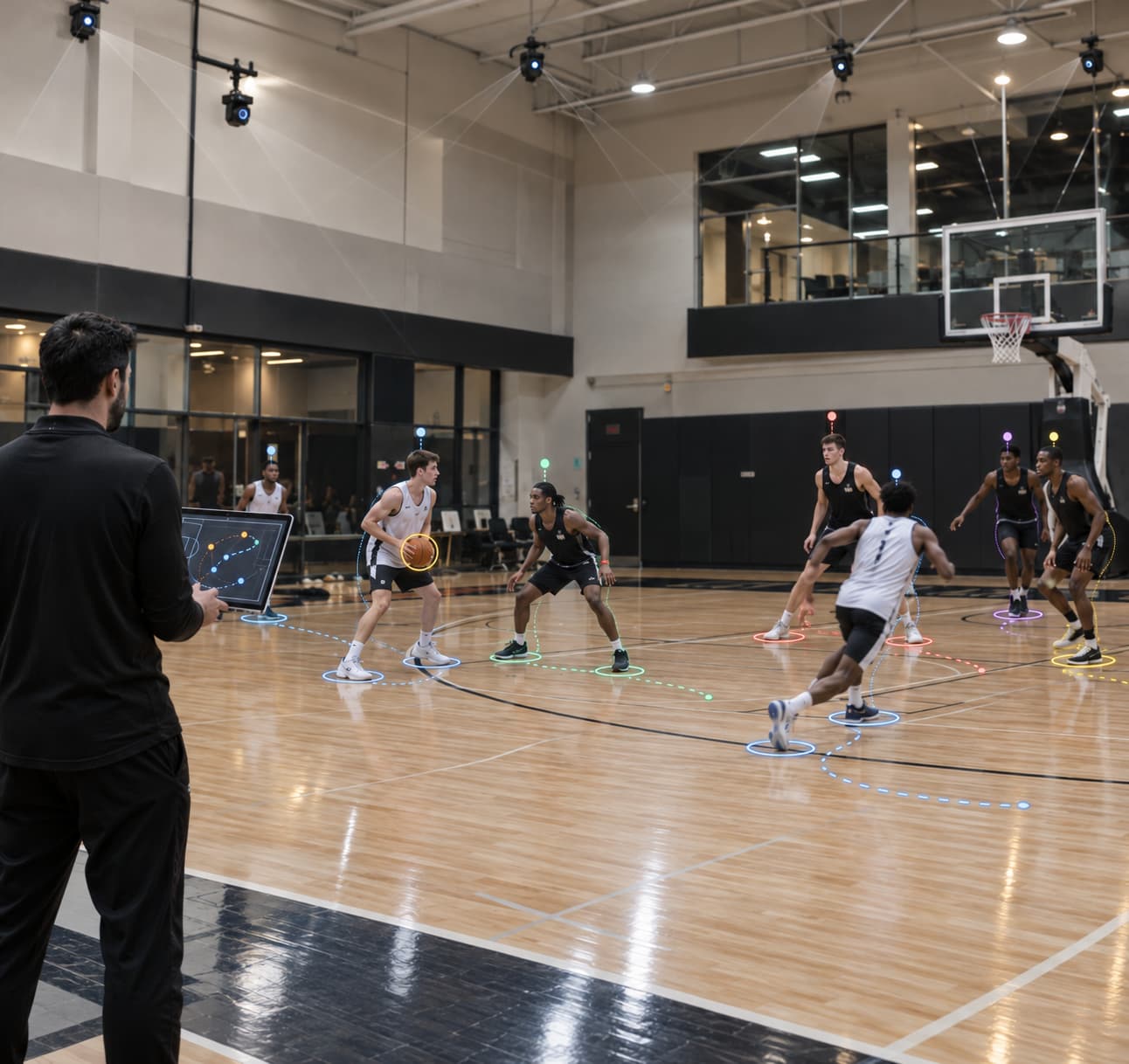
Basketball statistics have traditionally focused on actions that are easy to count: points, rebounds, assists, steals, and blocked shots. Yet some of the most valuable contributions happen when a player never touches the ball. A shooter running toward the corner can pull a defender away from the basket, while a well-timed screen can open a driving lane for a teammate. These movements often disappear from the box score, even though they directly influence the outcome of a possession. Artificial intelligence and optical player tracking are beginning to make these hidden contributions measurable. By analyzing the movement of all ten players, modern systems can reveal how offensive spacing develops, how defenders react, and how opportunities are created before a shot is taken.
How Computer Vision Tracks Every Player
Modern basketball tracking systems use cameras positioned around the arena to record the location and movement of players throughout a game. Computer vision software processes the images, identifies individual players, and estimates their positions on the court. These coordinates can be combined with information about the basketball, allowing analysts to reconstruct how an entire possession develops. Earlier tracking technologies primarily focused on player locations, but newer systems capture far more detailed information about body movement and positioning.
The NBA introduced Sony’s Hawk-Eye three-dimensional optical tracking technology during the 2023-24 season. The system can track 29 points on each player’s body, including joints and other anatomical reference points, at a frequency of 60 times per second. This provides considerably more information than simply recording where a player stands. Analysts can examine body orientation, movement patterns, and the changing distances between offensive and defensive players. Machine learning models process these measurements to identify patterns that would be difficult to recognize consistently through manual video review.
Understanding the Value of Off-Ball Movement
Consider a possession in which a guard dribbles toward the basket while a dangerous three-point shooter moves along the opposite side of the court. The shooter’s defender follows closely because leaving him open could result in an uncontested shot. As a result, the defender is unavailable to help stop the drive. The guard reaches the basket and scores, receiving two points in the box score, while the shooter receives no statistical credit. Nevertheless, the shooter’s movement helped create the opportunity by keeping a defender occupied.
Tracking data allows analysts to examine this sequence more precisely. By measuring the distance between the shooter and his defender, the defender’s movement toward the perimeter, and the space created near the basket, researchers can estimate how off-ball positioning influenced the defense. Similar analysis can identify situations where a player cuts toward the rim, forcing defenders to collapse and leaving a teammate open elsewhere. These relationships are especially important in modern offenses that depend on constant movement and coordinated spacing. Rather than treating the player with the ball as the center of every possession, tracking systems provide a more complete picture of how all five offensive players contribute.
Measuring Player Gravity With AI
One of the most interesting developments in basketball analytics is the attempt to measure player gravity. In basketball, gravity describes the defensive attention a player attracts because of his scoring ability or threat to receive the ball. A dangerous perimeter shooter may draw defenders farther from the basket, while a powerful interior scorer can force opponents to protect the paint. Traditionally, coaches recognized this influence through film study, but assigning it a consistent numerical value was difficult.
During the 2025-26 season, the NBA introduced a new gravity statistic developed with Amazon Web Services. The system uses positional tracking data and machine learning to compare the defensive pressure a player actually receives with the pressure expected from his location and the position of the ball. The difference helps estimate how much additional attention that player attracts. The NBA separates on-ball and off-ball gravity, including measurements for perimeter and interior situations. In January 2026, the league explained that the metric is designed to recognize players who change defensive positioning even before receiving a pass.
A player with high off-ball gravity does not necessarily lead the team in points or assists. His presence may force defenders to stay close, opening opportunities for teammates elsewhere. However, gravity should not be interpreted as a complete measure of offensive value. It estimates defensive attention relative to expectations, not the exact number of points created by an individual movement. The quality of teammates, offensive strategy, defensive scheme, and game situation all influence how that attention translates into scoring opportunities.
Screens and Cuts That Traditional Statistics Miss
Screens provide another example of valuable actions that frequently receive limited statistical recognition. Imagine a forward setting an off-ball screen near the three-point line. A teammate uses the screen to move toward the wing, forcing two defenders to communicate and decide whether to switch assignments. During that brief hesitation, another offensive player cuts into the space behind them and receives a pass near the basket. The final statistics may credit the passer with an assist and the cutter with two points, while the player who initiated the action through the screen receives nothing.
Computer tracking can help analysts identify the sequence behind the basket. A system can examine how close players were before the screen, how defenders adjusted their paths, and whether the action created additional separation between the offense and defense. By comparing many possessions, teams can investigate which combinations of players repeatedly generate favorable situations. The challenge is distinguishing intentional screens from incidental proximity and recognizing when a defender changes direction for reasons unrelated to the screen. Automated analysis can identify promising patterns, but video review remains necessary to understand the tactical context.
Off-ball cuts can be evaluated in a similar way. A player moving behind the defense may not receive the ball, yet his movement can force another defender to rotate and expose an open passing lane. Tracking systems can measure the timing, direction, and speed of the cut, then examine the defensive response. These observations help explain why some offensive possessions create open shots through coordinated movement rather than individual dribbling skill.
What AI Tracking Still Cannot Explain
Despite its capabilities, optical tracking does not fully understand a player’s intentions. Cameras can establish where athletes move, but they cannot always determine why a defender abandoned an assignment or whether an offensive movement was deliberately designed to create space. Defensive schemes, verbal communication, fatigue, and tactical instructions can produce similar movement patterns for different reasons. A defender moving toward the basket might be reacting to a cutting player, following a planned rotation, or recovering from an earlier mistake. Statistical models must infer these relationships from observable behavior.
Tracking systems also face technical limitations. Players frequently overlap from camera perspectives, rapid movements can complicate identification, and occasional tracking errors require correction. Machine learning models depend on the quality and representativeness of their training data. A metric developed from professional NBA possessions may not perform equally well when applied to youth basketball or competitions using different tactical approaches. Analysts must also distinguish correlation from causation. An open shot occurring after a particular cut does not prove that the cut alone created the opportunity. Reliable evaluation requires repeated observations, appropriate comparisons, and an understanding of the surrounding game situation.
How Coaches Can Use Off-Ball Tracking Data
For professional teams, the greatest value of AI tracking lies in connecting numerical analysis with tactical decisions. Coaches can use movement data to examine how effectively players maintain spacing, how quickly defenders respond to screens, and which offensive combinations consistently create separation. These observations can guide practice sessions and help identify weaknesses that traditional statistics overlook. A player who rarely scores might still be essential to the offense because his movement repeatedly attracts defensive attention or creates opportunities for teammates.
Tracking technology also changes how analysts evaluate basketball performance. In a 2025 study published in Scientific Reports, researchers examined NBA positional data to investigate how individual players influence defensive positioning. Their analysis illustrated that different offensive stars attract defensive attention in different areas of the court, depending on their playing styles. This type of research demonstrates how movement data can add context to established measures of performance.
However, advanced tracking systems remain expensive and require substantial technical infrastructure. Smaller clubs and amateur teams may rely on ordinary game recordings, manual tagging, and simpler video-analysis tools. Although these methods cannot reproduce every measurement available in professional systems, coaches can still examine off-ball screens, defensive rotations, and cutting patterns through systematic film review.
The growing use of AI player tracking does not mean traditional basketball statistics are becoming irrelevant. Points, rebounds, and assists remain essential measures of game performance. What tracking provides is a missing layer of context, revealing how valuable actions occur before those familiar statistics are recorded. By making movement away from the ball more visible, basketball analytics can better recognize the teamwork, spacing, and tactical decisions that shape every successful possession.